


Emergency Lighting
Installation, operation, and maintenance.
Emergency lighting: installation, operation, and maintenance.
Published February 2026
Keywords
Share
Background
Emergency lighting is discussed in the Ontario Electrical Safety Code under Section 46. This section applies to the installation, operation, and maintenance of the emergency system.
In recent years, the Code has made a distinction between emergency systems and life safety systems. Emergency lighting intended to provide illumination for evacuating a building/plant in the event of failure of normal power supply is considered to be part of the Life Safety System.
Life Safety System power supply is also governed by National Building Code of Canada.
Project/Case
Emergency power supply for lighting could be:
- A feed from an emergency generator
- Unit equipment = battery unit
- An inverter (example project)
Recommendations
When batteries are used as a source of emergency power supply, they can be purchased with an auto-testing feature. This can be a measure to lower maintenance costs since the Code Section 46-102 requires for testing of the power source “at least once every month”.
Also, for the same reason it is advisable to have one larger battery unit — for example, 360 watts that will feed several remote 9-watt heads — instead of having each head with a battery as shown in Example 2A.
Example 1
Example 1: In this case, the Exit sign is a combination Exit sign/battery pack with one–two remote heads connected to it. The power source is normal power and the emergency power source is the battery unit inside the sign.
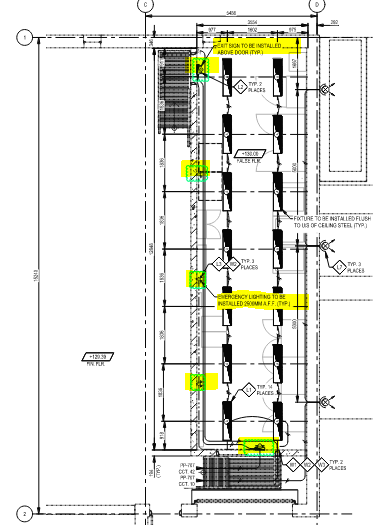
Example #1
Example 2
Example 2A: Basement has 8 batteries with double heads instead of having one battery with 8 remote double heads.
- Advantage: Reliability is higher — using 8 batteries instead of one is better, in case one battery fails.
- Disadvantages:
- The cost is higher to install 8 batteries (8*300=$2,400 USD versus 1*600+ 8*44=$952 USD).
- The maintenance is a higher cost. By code, each battery is required to be verified and test every month.
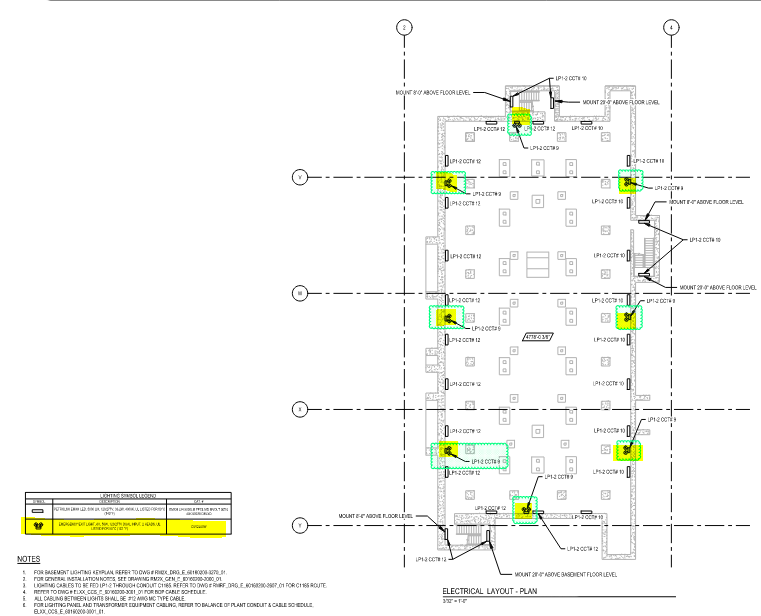
Example 2A
Example 2B: An inverter is used for power source for emergency lighting. If this would be installed in Canada, the inverter needs to have a CSA approval CSA C22.2 No. 141 to be used in an emergency system.
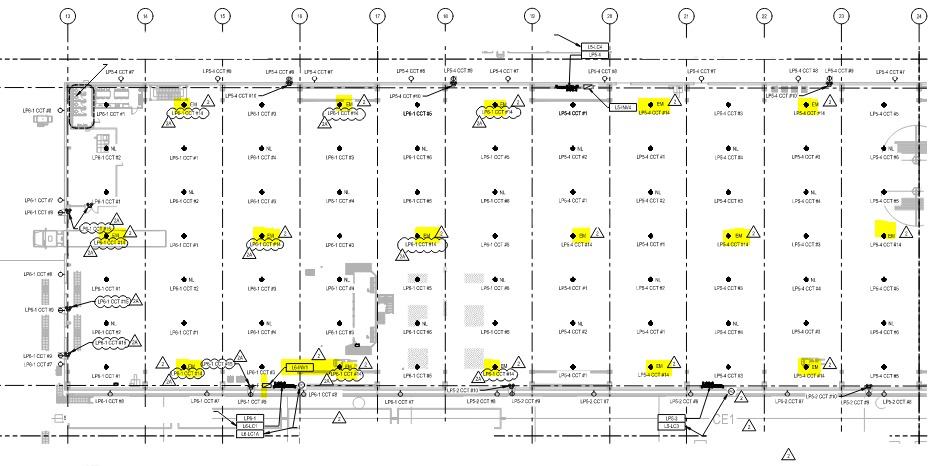
Example 2B
Is emergency lighting required in any building? What is the lighting level that is required in case of an emergency and where is that required by Code?
This will be answered by Ontario Building Code, under Section 3.2.7 Lighting and Emergency Power Systems.
3.2.7.3. Emergency Lighting
(1) Emergency lighting shall be provided to an average level of illumination not less than 10 lx at floor or tread level in.
(a) Exits.
(b) Principal routes providing access to exit in an open floor area and in service rooms.
(c) Corridors used by the public.
(d) Corridors serving patients’ or residents’ sleeping rooms in a Group B, Division 2 or 3 occupancy.
(e) Corridors serving classrooms.
(f) Underground walkways.
(g) Public corridors.
(h) Floor areas or parts of them where the public may congregate in:
(i) Group A, Division 1 occupancies, or;
(ii) Group A, Divisions 2 and 3 occupancies having an occupant load of 60 or more.
(i) Floor areas or parts of them in day care centres where persons are cared for.
(j) Food preparation areas in commercial kitchens.
(k) Principal routes providing access to exit in a floor area that is not subdivided into rooms or suites of rooms served by corridors in a business and personal services occupancy, a mercantile occupancy, or an industrial occupancy.
(l) Internal corridors or aisles serving as principal routes to exits in a business and personal services occupancy, a mercantile occupancy, or an industrial occupancy that is subdivided into rooms or suites of rooms, and is not served by a public corridor, and;
(m) Washrooms with fixtures for public use.
(2) Emergency lighting to provide an average level of illumination of not less than 10 lx at floor or catwalk level shall be included,
(a) In a service space referred to in Sentence 3.2.1.1.(9), and;
(b) On a shelf and rack storage system, in locations described in Sentence 3.16.1.5.(2).
(3) The minimum value of the illumination required by Sentences (1) and (2) shall not be less than 1 lx.
(4) In addition to the requirements of Sentences (1) to (3), the installation of battery-operated emergency lighting in health care facilities shall conform to the appropriate requirements of CSA Z32, “Electrical Safety and Essential Electrical Systems in Health Care Facilities”.
There is a code reference for exits and power source to lighting.
3.2.7.4. Emergency Power for Lighting
(1) An emergency power supply shall be:
(a) Provided to maintain the emergency lighting required by this Subsection from a power source such as batteries or generators that will continue to supply power in the event that the regular power supply to the building is interrupted, and;
(b) So designed and installed that upon failure of the regular power it will assume the electrical load automatically for a period of:
(i) 2 h for a building within the scope of Subsection 3.2.6.,
(ii) 1 h for a building of Group B major occupancy classification that is not within the scope of Subsection 3.2.6.,
(ii.1) 1 h for a building that contains a Group C major occupancy retirement home and that is not within the scope of Subsection 3.2.6.,
(iii) 1 h for a building within the scope of Article 3.2.2.43A. or 3.2.2.50A., and
(iv) 30 min for any other building.
(2) If self-contained emergency lighting units are used, they shall conform to CSA C22.2 No. 141, “Emergency Lighting Equipment”.
Codes and Standards
- Ontario Electrical Safety Code (OESC) (Latest Edition): Section 46
- Ontario Building Code: Section 3.2.7