

News

Typical Utility Station Details and Design
Utilities in a process plant are services which are not integral to the process, however, are still essential to plant operation.
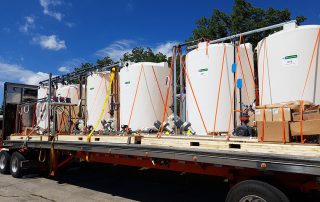
Delivering Exceptional Fluoride Removal — Right to Your Door
JNE Environmental has designed, built in-house, and shipped Fluoride batch treatment and pH correction systems to an ultrapure chemical manufacturer in Reno, Nevada. The fluoride treatment system is comprised of an incoming equalization tank, a specialized cone-bottom reaction tank, sludge waste holding tank, and a discharge effluent equalization tank to allow for safe discharge into the sewer system.

Carbon Dioxide pH Correction System is an Eco-Friendly Treatment Solution
JNE Environmental has developed a cost-effective and environmentally-friendly pH correction solution — using the same principles as carbonated soda. This process can achieve the desired pH correction without the use of expensive plastics, dangerous industrial acids, or specialized protective equipment, and does not result in the addition of Chlorides or Sulfates.

The JNE Group is hiring!
Join a dynamic, growing team of professional engineers and designers working with innovative projects, coupled with the opportunity to develop your career in Canada & the USA. We can offer a full range of benefits, flexible working hours, and a commitment to individual safety.

JNE to present at AU Las Vegas 2019
In November 2019, JNE will be presenting at AU Las Vegas — Autodesk’s premiere North American conference. JNE’s presentation, an instructional demo on 3D multi-disciplinary plant engineering, was selected from over 2,400 applications. This is a tremendous opportunity for JNE to share our knowledge of 3D software and applications on a world-class stage.
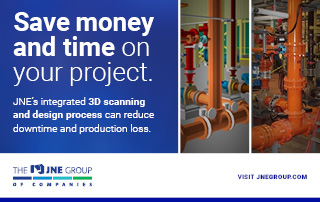
Integrating 3D Scanning and Design to Save Time and Money
Save money and time with our integrated 3D scanning and design services. JNE's process can help you achieve a more efficient project implementation cycle, reducing site visit time and cost and minimizing down time and production loss.
JNE Automation Celebrates 20 Years in Business
JNE Automation, your team of experts in automated control systems, is celebrating 20 years in business. Since 2001, JNE Automation has partnered with world-class companies and suppliers in various industries, bringing the latest technology and automation techniques to our clients, and developing new automation applications.

Ted Tandon recognized by PEO for Engineering Excellence
The JNE Group is proud to announce that our very own Ted Tandon, P.Eng has been awarded the 2021 Ontario Professional Engineers Engineering Medal for Engineering Excellence. This award recognizes professional engineers in Ontario who have made outstanding contributions to their profession and their community.